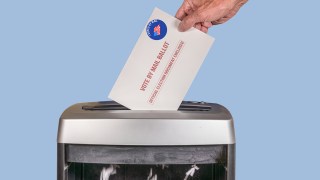
The SAVE Act would make it harder to vote — and not just for noncitizens



Given the volume and magnitude of actions taken by the White House since Inauguration Day, it is understandable that most of America’s attention has been focused on the executive branch. What should not be lost in this flurry of activity, however, is legislation being advanced by the 119th Congress that could be just as consequential to the institution most fundamental in a representative democracy: the vote.
The Safeguard American Voter Eligibility Act, or the SAVE Act, would require individuals to provide documentary proof of U.S. citizenship to register to vote in federal elections. It passed in the House in July of 2024 but did not advance in the Senate. Recently reintroduced by Rep. Chip Roy of Texas, the bill now has a heightened chance of success given partisan unity within government.
The consequences of the SAVE Act belie its name by compromising access to the ballot for large swaths of the populace and complicating an already overly complicated process. Moreover, the act undermines the ideals of the “democratic experiment” begun nearly 250 years ago of a republican form of government — an experiment that, until recently, has trended toward expanding rather than restricting suffrage.
The ostensible purpose of the SAVE Act is to curb voting in our federal elections by those who do not hold American citizenship. It would do so by prohibiting states from accepting and processing applications to register to vote unless the applicant presents proof of U.S. citizenship. These forms of proof include military IDs, birth certificates, passports and state-issued Enhanced Drivers Licenses that provide proof of identity and U.S. citizenship (the latter of which is available in only five states). Those who present a birth certificate face the additional requirement of showing a photo ID matching the information contained on a birth certificate.
Requirements safeguarding the voting process and ensuring that only those eligible to vote in federal elections are understandable and necessary. In fact, there already is law in place barring those without citizenship status from voting in federal elections. In truth, the proposed legislation is tantamount to a solution in search of a problem — research conducted by the Bipartisan Policy Council found only 77 instances of noncitizens voting between 1999 and 2023.
The impact of the SAVE Act stands to lessen the likelihood of voting for those who already are burdened by voter registration requirements. Rates of voting in the United States consistently lag comparable democracies, and a vast body of scholarship attributes the gap to the manner in which Americans hold elections. Voting in the United States takes resources including time, education, skill and stability; political science research consistently has concluded that the nation’s voting infrastructure unequally burdens those lacking such resources.
The Campaign Legal Center argues that the act “would exclude millions of eligible Americans from registering and voting simply because they lack the necessary paperwork to satisfy its extreme documentation requirements.” Even licenses that satisfy the Real ID requirement don’t meet the citizenship requirement, meaning most Americans will not be able to register to vote using their driver’s license alone. The act also stands to upend such facilitative registration systems as online and mail-in voter registration that have played a meaningful role in recent upticks in youth voter registration.
An additional group unequally burdened would be women. As PolitiFact points out, the requirement that those who present a birth certificate must also show a photo ID matching the information contained on their birth certificate could make voter registration harder for people who change their names when getting married. The overwhelming majority of people who change their names after marriage are women.
The power to determine who represents us in office is the hallmark of a republic, making fair and equal access to voting essential. Throughout the nation’s history, constitutional amendments and landmark legislation ranging from the Voting Rights Act to the Americans with Disabilities Act have broadened the franchise making the promise of American democracy a reality for “we the people.” As the nation prepares to celebrate the 250th anniversary of the Declaration of Independence, it seems an unfortunate moment to undermine this promise.
Elizabeth C. Matto, Ph.D., is director of the Eagleton Institute of Politics and a research professor at Rutgers University.
Copyright 2023 Nexstar Media Inc. All rights reserved. This material may not be published, broadcast, rewritten, or redistributed.
More Campaign News


Log Reg