On free speech, universities need to look in the mirror



Last week, in an appearance at Hamilton College, former President Barack Obama urged universities to stand up to the Trump administration’s attacks on freedom of speech. He also said they should reflect on how they might have restricted free speech themselves.
Can we say both things at the same time?
I think we can, and we should. But most of my colleagues think otherwise. If we admit to any inconsistency or wrongdoing, they say, we will be “complicit” with Trump’s “narrative” about higher education.
We will also be engaging in “whataboutism,” which is the biggest sin of all. It normalizes President Trump by equating him with his opponents.
So let’s get one thing straight: There is no equivalence — none — between Trump and the universities he has targeted.
First, and most obviously, he has more power than we do. He’s the president, after all.
And he has abused that power by withdrawing federal funds from the University of Pennsylvania — where I teach — and several other institutions. The law says the government can’t pull money from a school without a formal hearing and a report to Congress.
That hasn’t happened, so we don’t know what the Trump administration has in store for other universities. And that might be the most chilling thing of all.
How many schools will be willing to speak out and risk getting cut off by Trump? It’s a short list thus far, headed by Princeton and Brown. Almost everyone else is biting their tongue out of fear, which is the enemy of free speech in all times and places.
But if we’re honest, we will admit that we, too, have created cultures of fear in higher education. In December 2024, before Trump returned to the White House, a survey of over 6,000 faculty members at 55 colleges and universities showed that one in four often felt afraid to express their opinions because of how colleagues or students might respond.
Nearly half of conservatives felt that way, but almost one-fifth of liberals were also scared to say what they thought.
“Even as a tenured full professor, I feel pressure to conceal certain opinions,” a professor at the University of Texas-Austin wrote. “The atmosphere in certain academic units can be cult-like and fascistic and I really feel like I have to pick my battles.”
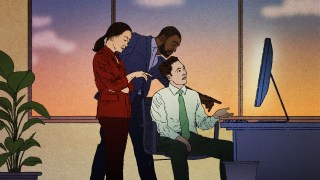
I got a glimpse of that fear at a recent meeting of educational researchers, which began with a panel of professors who denounced Trump’s campaign against free speech and open inquiry. Nobody made any reference to the fears that preceded him. So I raised my hand and asked whether we could use this moment not just to circle the wagons, but also to look in the mirror.
Perhaps I picked the wrong battle.
A scholar in the audience condemned my use of the phrase “circle the wagons,” which she said was an “anti-indigenous” vestige of “settler colonialism.”
If we lived fully by our ideals of free inquiry, the panel’s moderator would have said to the scholar, “Thanks for your comment. Can you please say more about why you object to that phrase?”
Then the moderator would have turned to me and said, “Jon, you’re a historian. What do you think about what you just heard? How do words change their meaning across space and time, and how should we decide which ones to use?”
None of that happened, of course. A panelist thanked the scholar for reminding us to be more “precise” and “careful” in our language about race, and nothing more was said. So the session began with a set of complaints about Trump’s attacks on free speech, and it ended with a warning to watch our words.
Afterwards, several people told me privately that they wondered what was wrong with saying “circle the wagons.” But they were too scared to ask during the panel discussion. Again, why stick your neck out?
I have nothing against the scholar who criticized my use of the term; to the contrary, I admire her for speaking her mind. My objection is about our culture of fear, which prevented all of us from learning from each other.
That’s on us, not on Trump. And nobody will listen to us if we pretend otherwise.
Even before Trump’s attacks, just over a third of Americans said they trusted higher education. We can’t restore that trust — and resist Trump’s incursions on free speech — unless we come clean about our own inconsistent defense of it.
That’s not a capitulation to Trump and his allies like Vice President JD Vance, who infamously denounced universities as “the enemy.” Instead, it’s a way to win back moderate and independent Americans who are turned off by our self-righteous word-policing.
“If you are a university, you may have to figure out, are we in fact doing things right?” Obama told his audience at Hamilton. “Do we stand up for freedom of speech when the other person talking is saying stuff that infuriates us and is wrong and hurtful? Do we still believe in it?”
That’s the question of our time. If we still believe in free speech, we will join hands to rebut Trump’s brazen attacks on it. But we will also look inwards, and ask how we might have forsaken it ourselves. Anything less will make us look cowardly and small, which is exactly what Trump wants.
Let’s listen to Obama instead.
Jonathan Zimmerman teaches education and history at the University of Pennsylvania. He serves on the advisory board of the Albert Lepage Center for History in the Public Interest.
.
Copyright 2023 Nexstar Media Inc. All rights reserved. This material may not be published, broadcast, rewritten, or redistributed.



Log Reg