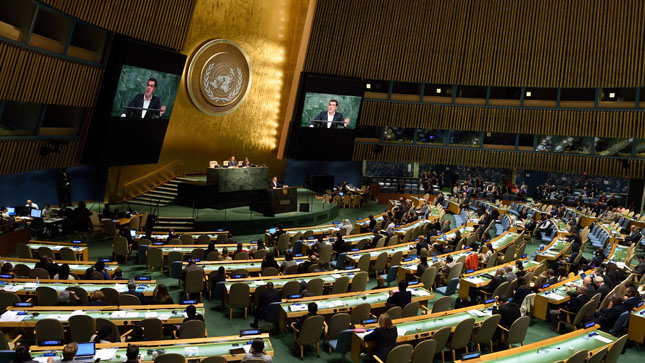
In alignment with this goal is news that President Barack Obama is seeking to reinforce the current taboo against nuclear testing through a non-binding U.N. resolution. Some have characterized this initiative as an “end run” around the Senate. It is not.
{mosads}The Obama administration has made clear that this resolution would not place new restrictions on U.S. nuclear testing, nor interfere with the Senate’s role in ratifying treaties. This same point was made earlier this year when administration officials explicitly testified before Congress that the administration would not pursue a path at the United Nations that would circumvent the Senate’s role in ratification of the Comprehensive Nuclear Test Ban Treaty (CTBT).
In fact, the purpose of the administration’s proposed U.N. resolution is to strengthen and reinforce the de facto global nuclear testing moratorium. It would also encourage the eight hold out countries needed to ratify the treaty—including the United States—to do so. This is a key step to bring the CTBT into full legal force and permanently end nuclear test explosions.
Between 1945 and 1998, seven nations conducted more than 2,000 nuclear test explosions, most of which were used to perfect new and more deadly types of nuclear weapons. In 1996, the United States pushed test ban treaty negotiations to a conclusion. Since then, 183 states have signed the treaty. In this century, only one country—North Korea—has conducted nuclear test explosions.
The nuclear test ban treaty also established a global monitoring and verification system for weapons tests which is now operating and demonstrating capabilities that have surpassed expectations. While the United States does have its own national technical means to detect nuclear tests, the treaty’s international system expands our testing detection and deterrence capabilities and adds the credibility of being under the control of a neutral organization. For this reason, it is shocking that some in the Senate have threatened U.S. contributions to fund this international system in order to make a political point in response to the mischaracterized “end run” threat.
In this geopolitical environment, we cannot afford to be unclear about the global norm against testing, nor about the permanence of effective monitoring and verification. U.S. inaction on treaty ratification has already provided other states, including China, India, and Pakistan, with cynical excuses not to act. Russia has ratified the CTBT, but as the treaty languishes, a different Putin political calculation is a real threat. The weariness of the world waiting for this promised treaty may well erode support and needed cooperation for the monitoring and verification system’s effectiveness.
If the fragile nuclear testing taboo goes away, it would not be a minor loss, but rather a game-changing security threat. Explosive nuclear tests would significantly accelerate a nuclear arms race by enabling new countries to join the race and other countries to greatly advance capabilities. Furthermore, every nuclear test incites a reaction; pretty quickly the escalation cycle has nowhere to go but to nuclear weapons use. This prospect is scarier when thinking of a particular example, like India and Pakistan for instance.
If global nuclear testing breaks out, the biggest security loser of all is the United States. We already have the most sophisticated nuclear arsenal on the planet, and for the last quarter of a century we have utilized a science-based stockpile stewardship program instead of conducting explosive nuclear tests. In fact, nuclear weapons scientists believe they have a better understanding and confidence in the reliability of U.S. nuclear weapons than when they were conducting nuclear test explosions. Now, there is simply no strategic value in U.S. resumption of explosive nuclear testing.
There is however a security imperative to thwart other countries from conducting nuclear test explosions. Even in the silly season of elections, it ought to be a bi-partisan, no-brainer to do everything we can to maintain the taboo against nuclear testing. Americans should all hope that U.S. security needs come before political games.
The views expressed by authors are their own and not the views of The Hill.