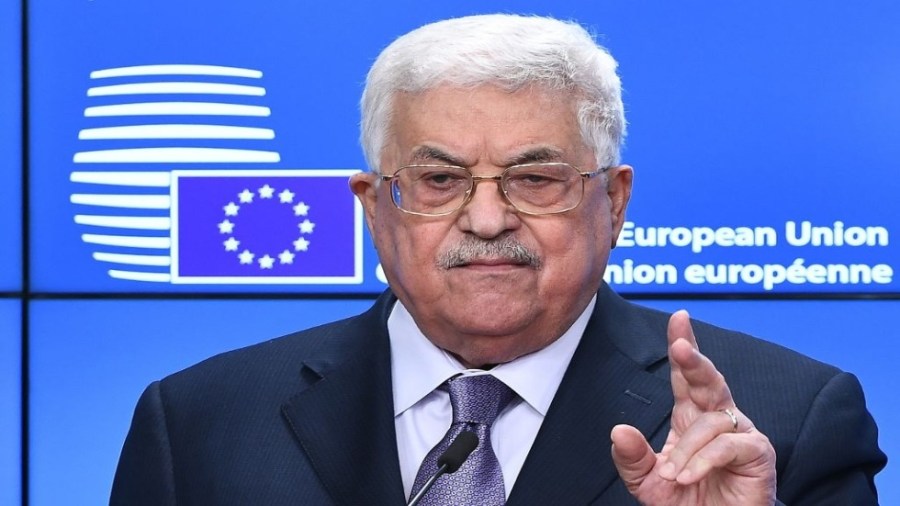
With apologies to Mark Twain, there are three kinds of lies: lies, damned lies, and the utterances of Mahmoud Abbas. Unless you’re a part of the Peace Process Cartel – the frustrated clique of former policymakers, Davos sophisticates, and international journo-tourists who remain committed to perpetuating the mistakes of the last quarter century – it’s pretty tough to take the Palestinian Authority president seriously.
Last month, Abbas went before a meeting of the United Nations Security Council to deliver a rambling, historically incoherent, extravagantly bitter broadside against those he believes are responsible for his people’s suffering – a group that does not include him or his corrupt, violent, incompetent government. This man who praises and financially incentivizes terrorists made demonstrably untrue statements such as, “We have thus been committed to fostering a culture of peace, rejection of violence.” In the midst of his tantrum, he managed to vomit out a precondition-laden proposal for renewed negotiations with the Jewish state. Carefully crafted to be a non-starter, his statement covered no new ground beyond efforts he has previously rejected. He then stomped out of the room so he wouldn’t have to listen to Israel’s ambassador respond. Some commitment to dialogue.
{mosads}But for the Peace Process Cartel, all Abbas has to do is wink in their direction.
One such cartel member, Jeremy Ben-Ami, president of J Street, an organization highly critical of Israel, tweeted: “In an important speech to the #UNSC, Palestinian President Abbas laid out explicit support for the 2-state solution and a serious proposal for getting there.” Ben-Ami also wrote a piece in the Forward in which, after acknowledging Abbas’ penchant for incendiary rhetoric, he says: “The standard for judging Abbas and Palestinian leadership today isn’t whether they love Israel but whether the positions laid out explicitly this week at the UN Security … can and should form the basis for ending the conflict.”
Ben-Ami’s timeline here is interesting. The standard for judging Abbas today is his statement at the UN last week. Regardless of what Abbas says next, one assumes the parts of that UN speech Ben-Ami liked will continue to be the standard until Abbas next says something Ben-Ami likes, regardless of the content of the interregnum.
What about Abbas’ statement to the Central Council of the Palestine Liberation Organization way back in January? Abbas said that Israel is a European colonial project that has “nothing to do with Jews” and spun a bizarre fiction that the Dutch brought the Jews to Israel at the behest of other European powers because they (the Dutch) had the biggest fleet of ships. What about Abbas’ past denial of the Holocaust and Jewish historical connections to Jerusalem? What about his claim from late 2015 that Jews desecrate the Temple Mount “with their filthy feet”? Can it be that the only words that matter are the most recent ones Jeremy Ben-Ami liked?
Peace Processors love to remind us that Yitzhak Rabin said in 1993, “You don’t make peace with friends. You make it with very unsavory enemies.” Ben-Ami, in fact, uses that quote in the above-referenced op-ed. Three things about this quote are worth noting: First, history has proven that Rabin was wrong to enter into the Oslo process with Palestinian leader Yasser Arafat. Arafat was not ready to make the kind of concessions necessary for peace and never gave up terrorism as a tool to achieve his goals. Second, if we accept the quote at face value, an enemy still needs the willingness to make peace and the ability to enforce it once made. Palestinian leaders have never shown any interest in the kind of cultural and social institution-building that would be necessary to foster and sustain a negotiated peace. Third, given his constant, unfair criticism of Israel and the standing ovations for Palestinian negotiator Saeb Erekat at the J Street conference in 2015, there’s no reason to believe that Ben-Ami and pro-Israel Americans agree on which party is the unsavory enemy.
Mahmoud Abbas only wants peace on the other side of victory – a victory that must be engineered for him by a third party since he cannot win it on the battlefield. The Peace Process Cartel only wants what all cartels want: to keep prices high and alternatives out of the market. That they now collude with one another may be unpleasant, but it’s hardly surprising.
Jonathan Greenberg is an ordained reform rabbi and the senior vice president of the news and public policy group Haym Salomon Center. Follow him @JGreenbergSez.