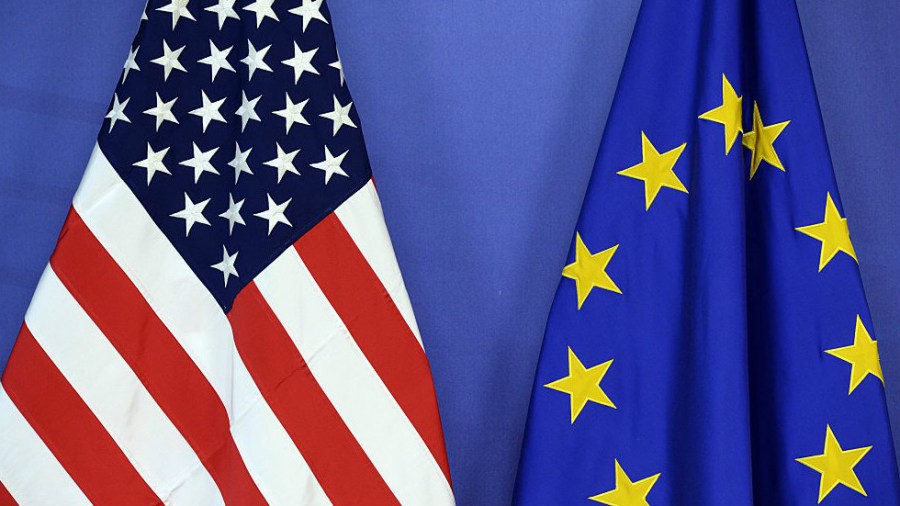
Pro-European Union parties won the Dutch elections, despite concerns that the far-right Freedom Party might ride a Europe-wide tide of populism to victory. For now, the threat of the EU’s demise has been postponed, but not eliminated.
American conservatives do not seem particularly bothered by the possible demise of the EU. President Trump, for his part, has expressed ambivalence over the EU, embracing Euro-skeptics such as the U.K. Independence Party, even saying the EU’s future does not matter to the United States.
The truth is, it matters tremendously — not least for American trade, foreign policy and national security.
The EU is far from perfect, but the United States must not lose sight of its many benefits. If America wants to be “great again,” it should support an EU strong enough to reform itself, and thereby remain a reliable U.S. ally.
{mosads}The European project was an integral part of the post-World War II security architecture, which the United States was instrumental in creating. The EU original core was the European Community of Coal and Steel, founded in 1951, pooling together industrial resources from former wartime foes Germany and France.
During the Cold War, Washington not only wielded the bloc as a useful tool in defending the West against Soviet encroachment, but also as an end in itself, bolstering stability, prosperity and the rule of law, thereby creating partners and markets for America.
This bet has paid off.
Trump has said that the EU was created to “beat the United States on trade.” Actually, the bloc is the single greatest market for American products. According to the Office of the U.S. Trade Representative, the EU-U.S. trade relation generates $2.7 billion daily in trade and services, and sustains 7 million jobs on both sides of the Atlantic, more than half of which are U.S. jobs. Overall, it is worth more than $1 trillion in bilateral trade per year.
But trade is not the whole story. Europe and America are more invested in each other’s economies than ever. U.S. investment in Europe is three times higher than in Asia, and EU investment in the U.S. is eight times what the bloc invests in China and India combined. And considering that the U.S. and EU are, globally, the first- and second-biggest economies in the world, together they are the global economy’s single most important drivers.
The ambivalence of some American conservatives toward the EU is influenced by their disdain for its multilateral government structure. However, Brussels is neither a bloated bureaucracy nor an elitist government of unelected mandarins, as some critics claim.
It is a small cadre of bureaucrats to whom member states have voluntarily granted limited powers over some spheres — a concept that American federalists understand well. The European Commission’s bureaucracy employs just under 33,000 public servants. That’s a far cry from New York City’s nearly 450,000 or the U.S. federal government’s nearly 2.7 million employees.
Member states appoint commissioners, who are then confirmed through hearings by the elected European Parliament. Laws and regulations are approved by the European Council, a mini-parliament composed of elected heads of government. The implementation of laws is regulated by treaties approved through democratic procedures.
Despite claims to the contrary, the EU has actually cemented democracy and the rule of law across the continent remarkably well. Over the years, the prospect of EU membership helped many former dictatorships transition to democracy, including, most recently, former Warsaw Pact communist regimes, plus Slovenia and Croatia.
In each case, NATO offered security guarantees while the EU provided the legal framework and economic incentives to consolidate democratic governance. Admittedly, some new EU member states in Eastern Europe have suffered authoritarian backslides, but on balance, membership has been a powerful disincentive against reverting to their illiberal past.
American conservatives should also celebrate the EU for its commitment to solid finances, fair competition and market economies. The EU sovereign debt crisis did not happen because of EU profligacy or socialism. In fact, it was a result of member states cheating EU budgetary rules.
Disasters like the Greece debt crisis happened because elected politicians wanted to be part of the EU while not abiding by its wise financial guidelines.
Critics of the EU have viewed the euro currency as an unfair burden on national governments facing debt, as it prevented them from manipulating their currency. Yet membership in the eurozone allowed nine EU member states to delay their entry and use their national currencies instead.
Besides, national currency devaluations often fail; they can destroy middle-class savings in the process. The eurozone prevented such a meltdown from happening and, despite the pain of continent-wide austerity, recent indicators show that the European economy is rebounding.
Criticisms of EU foreign policy are common. It can certainly be frustrating to get all 28 countries to agree on a joint foreign and security policy. But the EU has come together when it counts.
Take EU sanctions against Iran during the 2010-2013 period. Both supporters and opponents of the 2015 Iran nuclear deal concur that Iran would not have negotiated restrictions over its nuclear program had it not been for EU sanctions between 2010 and 2013. Had it been up to single member states, probably half would have declined to endorse those measures.
(Greece, Spain, and Italy were buying significant quantities of crude from Iran, for instance; Sweden had important telecom contracts at stake; France‘s car industry had lucrative deals with Iran’s counterparts; and Malta benefited from maritime trade with the Islamic Republic.)
The same is true today with sanctions on Russia. EU countries conduct significant trade with Russian firms and buy Russian energy. Targeting Moscow is not popular in many European capitals. Besides, even capitals that are supportive of Russia sanctions could turn overnight based on the latest election results, especially since the Kremlin has been asserting its influence across Europe.
The EU collective foreign-policy bargain mechanism insulated its member states from such swings and pressures. Those reluctant to endorse Russia sanctions — as was once the case with measures against Iran — have been coaxed into doing so. And once these measures pass, walking back is virtually impossible unless there is a new consensus among the members.
Some conservatives still see such populists as better interlocutors than pro-EU governments because they embrace similar anti-elite sentiments. These movements, however, share few of Washington’s foreign policy goals. In fact, they frequently stand diametrically opposed to the Trump administration’s stated positions, whether on Russia’s illegal occupation of Crimea, or the Syrian crisis, to say nothing of their often pro-Russian, anti-Israel and anti-American stances.
There are and will always be things to find infuriating about the European Union. But the core values, historic bonds, and the strategic and economic interests we share far outweigh our differences.
The EU remains an essential part of the transatlantic alliance. It is in America’s interest to make sure it remains strong in the years to come as well.
Roland Freudenstein is the policy director for European Studies at the European People’s Party Wilfried Martens Center for European Studies. Follow him on Twitter @RoFreudenstein. Emanuele Ottolenghi is a senior fellow at the Foundation for Defense of Democracies. Follow him on Twitter @eottolenghi.
The views of contributors are their own and not the views of The Hill.