Trump tariffs on Canada, Mexico raises risks, tough choices for businesses



U.S. businesses are bracing for the impact of President Trump’s new tariffs on Canadian and Mexican goods.
After months of threats and pushed deadlines, Trump said Monday he would go ahead with implementing import taxes of 25 percent on goods from Canada and Mexico. The new tariffs, set to take effect Tuesday, would mark a drastic turning point in the relationships between the U.S. and its two closest trading partners.
Asked whether there was any opportunity for more negotiations with top U.S. trading partners Canada and Mexico before the tariffs are announced, Trump said there wasn’t. He originally promised the tariffs for Jan. 20 and then early February.
But the back-and-forth nature of Trump’s tariff threats have left business leaders holding their breath, plotting major changes in case the president opens a North American trade war.
This latest policy reversal has led to uncertainties in corporate boardrooms about where companies should be investing.
“As with other Trump tariff announcements so far, it’s hard to know if this is a bluff or a genuine turn in policy,” J.P. Morgan U.S. economist Michael Feroli and others wrote in a Monday analysis.
“Alternatively, at least the Canada and Mexico tariffs could get delayed again until after April 1, when the administration is set to publish the trade report the Trump asked for in his first day executive order.”
Canadian Prime Minister Justin Trudeau announced Monday night that his country would impose escalating reciprocal tariffs of 25 percent on U.S. goods if Trump went ahead with his import taxes. Ontario Premier Doug Ford went a step further, pledging to cut off energy exports to the U.S. if Canadians faced new tariffs.
Many businesses and trade groups have said that tariffs will increase costs for companies and could translate to price increases for consumers.
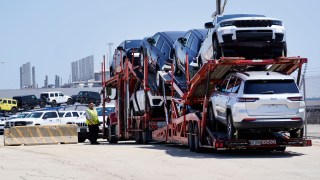
One analysis by Anderson Economic Group of the auto sector, which has production lines that are highly integrated across North American borders, predicted the cost per car of the 25 percent tariffs could be as much as $12,000.
Others have suggested the tariffs could take a bite out of gross domestic product (GDP).
“25 percent tariffs on Canada and Mexico, if sustained, could present a 0.4 to 0.7-percentage point drag on our baseline 2025 real GDP forecast of 2.5 percent and 0.3 to 0.7 percentage points to core PCE inflation this year,” Brett Ryan and others wrote Monday for Deutsche Bank.
Commerce Secretary Howard Lutnick paved the way over the weekend for Trump’s announcement, though he gave Trump some wiggle room because he has reversed his orders on tariffs in the past.
“I think there are going to be tariffs on Tuesday on Mexico and Canada. Exactly what they’re going to be, I’m going to leave that for the president to decide,” he said on Fox News. “He’s going to put them into place on Tuesday. The Canadians and the Mexicans have been talking to him.”
Trump sounded a bit more open to continued trade negotiations with China. An additional 10 percent tariff on top of an already established tariff of 10 percent also could go into effect Tuesday.
Trump declined to say how high a tariff he would levy against U.S. importers of Chinese goods, saying it depends on whether they depreciate their currency, a move that can make Chinese exports cheaper and undermine the effect of tariffs.
“It depends on what they do with their currency,” he said. “It depends on what they do in terms of a retaliation. … I don’t think they’re going to retaliate too much.”
Trump has been threatening tariffs against China, Mexico and Canada — the U.S.’s top three trading partners — on the grounds that the countries are effectively contributing to fentanyl imports to the U.S. and worsening the country’s opioid crisis.
Chinese embassy spokesperson Liu Pengyu referred to this argument as a “pretext” to threaten China.
“The U.S. once again uses the fentanyl issue as a pretext to threaten China with additional tariffs on its exports to the U.S.,” he said in an email to The Hill.
“The unilateral tariff hikes by the U.S. severely violate the [World Trade Organization] rules, and harm the interests of both countries and the world,” he added.
Trump also said retaliatory tariffs were set to take effect April 2.
Trump posted a warning to U.S. farmers on social media Monday, telling them to prepare for fewer export opportunities.
“To the great farmers of the United States: Get ready to start making a lot of agricultural product to be sold inside of the United States. Tariffs will go on external product on April 2nd. Have fun!” he wrote.
The Hill reached out to the White House for further information.
Trump imposed an initial 10 percent tariff on Chinese imports on Feb. 4. China responded with 10 percent and 15 percent tariffs on imports from the U.S. — mostly on the agriculture and energy sectors — in addition to new export controls and blacklisted company designations.
Trump canceled a tariff exemption for China on imports worth less than $800 at the beginning of February, but he quickly reversed the order after it proved unworkable and led to a pile up of packages at John F. Kennedy International Airport.
He restored the exemption pending the installment of “adequate systems” to deal with the bolstered trade regulations.
Asked about what systems they were implementing to deal with added inspection requirements, U.S. Customs and Border Protection (CBP) stressed the need for their agency to be flexible.
“The dynamic nature of our mission, along with evolving threats and challenges, requires CBP to remain flexible and adapt quickly while ensuring seamless operations and mission resilience,” the CBP said in an email to The Hill.
Updated at 1:34 p.m. EST.
Copyright 2023 Nexstar Media Inc. All rights reserved. This material may not be published, broadcast, rewritten, or redistributed.





Log Reg


