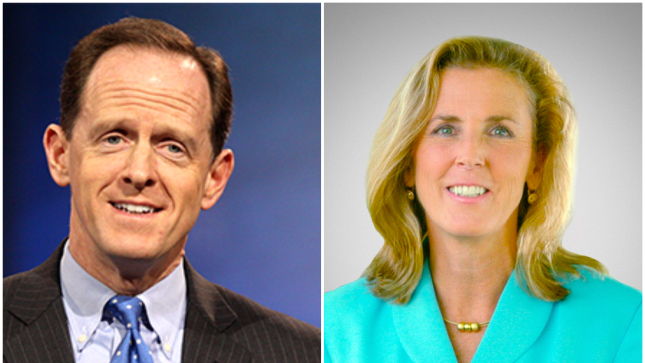
Sen. Pat Toomey is feeling the effect of Donald Trump’s sagging poll numbers in the critical battleground state of Pennsylvania.
Up until a few weeks ago, the Republican senator was consistently leading Democratic rival Katie McGinty in this year’s most expensive Senate race so far.
{mosads}But if Democratic presidential nominee Hillary Clinton maintains her double-digit edge in the Keystone State, pollsters and strategists don’t see how Toomey can withstand Trump’s down-ballot drag.
“That’s got to be a red flag for Toomey, who looked like he was cruising along,” said Tim Malloy, assistant director of the Quinnipiac University Poll, which has McGinty up 3 points and Clinton surging by 10 points. A month earlier, the survey had Toomey leading by 10 points and Trump, the Republican presidential nominee, by 2 points.
Political observers in the state say the Senate race is unequivocally tied to the top of the ticket. Trump has said he can put a Democratic-leaning state like Pennsylvania into play, but his dip in the polls there comes after a rough couple of weeks mired by controversial remarks and a major campaign shake-up.
Toomey, who hasn’t said whether he’ll vote for Trump, is left in a complicated situation as he seeks to keep distance and focus on his own race. Political observers say he’s been running a strong campaign, despite Trump’s standing in the presidential race.
“I don’t think he’s done much wrong in terms of his campaign,” said Chris Borick, a political science professor at Muhlenberg College. “I think he’s probably run a pretty decent campaign so far and trying to focus on things that he wants focused on.”
Borick added that McGinty’s lead can be largely attributed to Clinton’s success in the state.
“I don’t think she’s seized opportunities in particularly effective ways, yet she finds herself up in most polls, and the bottom line is it has everything to do with the top of the ticket right now,” he said.
McGinty’s campaign is trying to take advantage of that, arguing there’s little difference between the two Republicans.
“Pennsylvanians see clearly that this is the Trump-Toomey ticket, and they are already rejecting its divisive agenda,” said McGinty spokesman Josh Levitt.
Pollsters say that in order to win Pennsylvania, candidates need to perform well in the areas around Philadelphia. Terry Madonna, Franklin and Marshall College’s polling director, noted that Trump currently has a 20- to 30-point deficit in the Philadelphia suburbs where many of the state’s swing voters reside, though Toomey is performing better than him there.
Madonna said that Toomey’s biggest challenge will be to win over those voters, in addition to appealing to the blue-collar voters in the southwestern part of the state who currently sit in Trump’s camp.
“For the down-ballot races to be secure for the Democrats, Clinton has to carry the state by 5 [points] or more,” said Larry Ceisler, a Philadelphia Democratic strategist. “I think that’s what you’re seeing with that 9-point lead currently. That’s where Katie’s been benefited.”
Pennsylvania Republicans acknowledge Toomey’s uphill fight but say not to count him out, especially with a little less than three months to go and an expectation that polls will tighten in the fall.
“The general mood is one of concern for Sen. Toomey, but certainly not despair in any way,” said Charlie Gerow, a Pennsylvania GOP consultant.
“Most Republican leaders believe Pat Toomey can win. Once we get past summer vacations, the race will begin to take much more focus and attention.”
Republicans always expected a tough reelection for Toomey in a presidential year, since Pennsylvania hasn’t voted for a Republican presidential nominee since 1988.
But they remain hopeful about the state’s history of ticket-splitting. The last GOP senator there to win in a presidential year was 2004, when Arlen Specter won reelection when the state voted for Democratic presidential nominee John Kerry.
Toomey’s campaign is brushing off national politics and keeping the pressure on McGinty, a former gubernatorial chief of staff. The two have sparred on a host of issues, ranging from support for law enforcement to sanctuary cities.
“Regardless of what happens in the presidential race, Pennsylvanians will not send to the U.S. Senate someone who is as anti-jobs and weak on security as Katie McGinty, and they certainly don’t want a senator who would be a rubber stamp for Hillary Clinton,” said Toomey spokesman Ted Kwong.
The importance of this race, which could be pivotal in determining which party controls the Senate next year, can be seen by the TV ads currently flooding the markets by both the campaigns and outside groups. Open Secrets says the Pennsylvania race tops the Senate races thus far in spending at $25 million.
Senate Majority PAC, a super-PAC aimed at helping Democrats in the upper chamber, has already poured $2.6 million into the race, along with its 501(c)4, which has also spent $2.6 million. And Freedom Partners Action Fund, a super-PAC aligned with the Koch brothers, has also run ads backing Toomey.
But arguably Toomey’s most prominent backer comes from former New York City Mayor Michael Bloomberg, a leading gun-control advocate, who touted Toomey’s bipartisan work on gun measures. Toomey has co-sponsored legislation with a Democratic senator that would require background checks for more gun sales.
Bloomberg’s super-PAC, Independence USA PAC, ran an ad featuring the daughter of the Sandy Hook principal who was killed in the 2013 massacre in Newtown, Conn., who spoke in support of Clinton at the Democratic National Convention.
The ad, in which she explains why she is crossing party lines to support the Republican senator, helps strengthen Toomey’s message that he’s an independent leader. But McGinty pointed to his opposition to a recent Democratic measure that aimed to prevent suspected terrorists from purchasing firearms.
Toomey has said he agrees that terrorists on watchlists shouldn’t be able to buy firearms and has put forward an alternative bill that he says combines the best of Democratic and Republican proposals.
Toomey and McGinty’s differences will come to a head when they square off in two debates, but the GOP senator is calling for more, an unusual request from an incumbent. Gerow said this isn’t an admission of weakness, but a sign that Toomey believes this will benefit him and expose McGinty’s vulnerabilities.
“Generally,” he said of incumbents calling for more debates,“it’s an indication that they feel they’re in trouble,” Gerow said. “I think it’s just, with this particular situation, it’s because Sen. Toomey believes he’s a good debater, and I think he believes Katie McGinty’s weaknesses can be exposed in a debate.”
But Toomey this week also came out in opposition to President Obama’s signature Trans-Pacific Partnership (TPP). McGinty’s campaign was quick to hammer Toomey, pointing out that he voted for a fast track that would expedite trade deals.
Still, with fewer than 80 days left until Election Day and an ever-changing race, observers say there’s still a path for Toomey to survive this unconventional election year, even if Clinton carries the Keystone State.
“I think if it’s a low-single-digit race with Clinton winning, Pat Toomey could very easily survive,” Borick said. “I see enough split-ballot opportunities for him to do that.”
But Borick added the caveat that if the current numbers hold, it’s highly unlikely Toomey can stay afloat.
“It’s simply if it gets to the stage where we see them today, I think there’s not enough there and he’ll get dragged under.”