Rep. Levin known as trade critic, but his record on the issue is more complicated



Rep. Sandy Levin is known as a trade critic, but his record
on the issue is more complicated.
Levin (D-Mich.), who was named interim chairman of the Ways
and Means Committee after Rep. Charlie Rangel (D-N.Y.) stepped down under an
ethics investigation, has been a leader in the Democratic Caucus on trade for
years.
{mosads}He’s expressed skepticism of pending agreements with
Colombia, Panama and South Korea that were negotiated by the Bush
administration, leading some to think those deals are unlikely to be dislodged.
But in 2000, Levin voted for granting China more favorable
trade terms, which ushered that country into the global trading system and the
World Trade Organization.
Levin initially opposed that legislation, but later lobbied
members for support after winning concessions from the Clinton administration.
More recently, Levin helped negotiate changes to a trade
deal with Peru that allowed it to win congressional approval in 2007.
Some business lobbyists who’ve been hoping for action on the
Bush administration’s leftover trade agenda suggest things aren’t likely to
worsen for them with Levin at the helm of the committee instead of Rangel.
Others are hopeful that Levin could deliver for them.
Cal Cohen, president of the Emergency Committee for American
Trade, sees Levin as someone who could find middle ground. “Levin had issues he
wanted to address on China’s accession to the WTO, and it went forward,” he
notes.
Others on K Street still feel burned by the decision Speaker
Nancy Pelosi (D-Calif.) took to change House rules to prevent the Colombia deal
from coming up under the “fast-track” law. That law was supposed to ensure
consideration of the agreement under special rules. Both Rangel and Levin
supported Pelosi’s move.
Still, Levin’s and Pelosi’s records on trade are hardly
identical.
Pelosi voted against China’s entry to the WTO, and the two
also split on the other huge trade vote of the last two decades, the North
American Free Trade Agreement (NAFTA) with Canada and Mexico in 1993. Pelosi
voted for NAFTA, while Levin voted against it.
Rangel is thought to be more business friendly than Levin, a
point Rep. Paul Ryan (R-Wis.) made to The Hill this week. He said Levin is “not
nearly as pro-business as Charlie was.”
But Rangel and Levin voted identically on NAFTA and China.
Rangel also leaned on Levin on trade policy in recent years, and gave Levin a
full-throated blessing to take over the committee in his absence.
Levin is dealing with a divided caucus on trade, which makes
moving anything through Congress difficult.
More than half of the House Democratic Caucus has signed
legislation sponsored by Rep. Mike Michaud (D-Maine) that would force the
administration to renegotiate the NAFTA and other existing trade deals.
At least one sponsor of the Michaud bill though Levin’s
elevated position was good for that bill.
“I think that gives us a real fighting shot not only to get
the bill on the floor, but to get it passed,” said Rep. Phil Hare (D-Ill.) of
Levin’s new chairmanship.
But the Michaud bill is unpopular with the Ways and Means
panel. Only one committee member is a co-sponsor.
President Barack Obama in his State of the Union address
said he wanted to double U.S. exports over the next decade, and business groups
have stressed that passage of the trade deals would be a step in that
direction.
But the endless healthcare debate has kept trade on the back
burner, as the administration didn’t need to pick more internal fights with
Congress over trade while it sought to unite it on healthcare.
With healthcare finally headed toward the home stretch, it’s
possible that at least one of the deals could be considered this year.
Speculation has centered on the Panama deal, which is the least controversial.
Unions have drawn a sharp line on the deal with Colombia,
which they argue has not done enough to crack down on violence against labor
organizers.
The South Korea deal, however, could be the toughest for
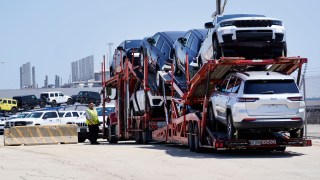
Levin. It would by far have the greatest economic impact on the U.S., but could
open the U.S. market further to Korean trucks by eliminating a tariff.
The United Auto Workers opposes the deal, as does the Ford
Motor Co., the only Big Three automaker that didn’t get a bailout from
taxpayers.
— Jay Heflin and Walter Alarkon contributed to this story
Copyright 2023 Nexstar Media Inc. All rights reserved. This material may not be published, broadcast, rewritten, or redistributed.


Log Reg


