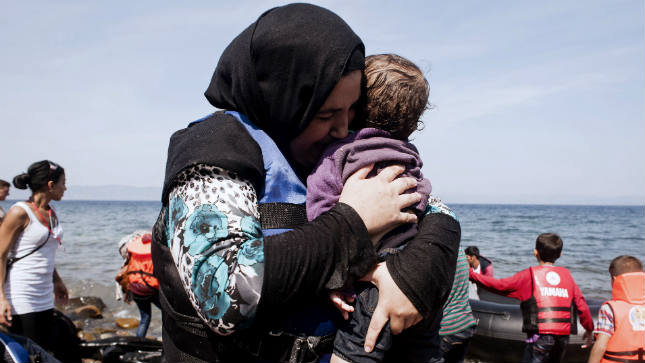
Long before Alan Kurdi’s tiny body washed up on a Turkish beach, Syrian children had been suffering horrifically from the war in Syria.
Toys and coloring books abound at torture treatment centers in Jordan, because the systematic use of torture by President Bashar Assad’s regime has included huge numbers of young boys and girls.
{mosads}Report after report documents the blood-chilling ways the children of Syria have been starved, sexually abused, tortured, enslaved, subjected to indiscriminate barrel bombs and murdered.
Last week, the Obama administration announced an incremental increase for global refugee admissions to the U.S. to 85,000, from 70,000, which is welcome but not remotely commensurate with the scope of the crisis.
What to do? For too many political leaders, the answer has become contingent on the larger question of what to do about the conflict in Syria. But as important as that question is, the desperate parents streaming out of Syria cannot afford to wait for a long-term solution. Solving this problem shouldn’t be partisan. And it doesn’t require a decision about cruise missiles or no-fly zones. It requires political will, money and compassion.
The vast majority of Syria’s 4 million refugees are not trying to get to Europe or the United States. They’re not in Austria, Hungary or Serbia. They are in Jordan (630,000), Lebanon (1.2 million), Turkey (1.8 million) and Iraq (250,000). Millions more are displaced within
Syria. And one day, as hard as it is to imagine now, most of them will return to the places where they grew up, where their grandparents are buried and where they speak the language.
In the meantime, we are facing a humanitarian nightmare of historic proportions. Responding to it means providing adequate support for Syrian refugees in the countries neighboring Syria until they can go home. Lebanon, Jordan and Turkey are overwhelmed. Necessities as basic as food have been perilously uncertain. Refugee children need schools, adults need work and families need stability. Without these basics, they seek relief elsewhere.
The United States deserves credit for contributing more money for Syrian humanitarian relief than any other country has. But it’s not nearly enough.
In addition, there are some refugees who are extraordinarily vulnerable and need immediate resettlement in third countries: children, religious minorities and torture victims, among them. The U.N. has registered fewer than 200,000 such refugees, but that number will certainly grow. Even if the number reaches 1 million, it will still mean that three-quarters of the estimated 4 million refugees will eventually return to Syria.
The world has the capacity to absorb the Syrians who can’t.
U.S. action on both fronts is crucial and interlinked. Some argue that we should just provide aid. But this ignores the dire circumstances of the most vulnerable refugees who urgently need permanent resettlement and the imperative for the United States to accept a part of the burden of resettlement if it is to play its traditional leadership role in this crisis.
As one of the largest, richest countries in the world, the United States should immediately announce that it will accept 100,000 of the most vulnerable Syrian refugees. That is the kind of commitment needed to rally others to do more.
Historically, the U.S. has accepted more refugees than all other countries combined. But our record on Syrians is shameful. This year we will probably take less than 1 percent of those needing immediate resettlement.
The administration’s announcement that it will increase the number of refugees accepted from all over the world by 15,000 is welcome but still woefully inadequate.
Some within the administration have suggested that congressional Republicans will stand in the way of bolder solutions. It is true that some Republicans have voiced strong concerns about resettling more Syrians in the U.S.
A few have engaged in outright fearmongering. But key Republican Senate chairmen have indicated a desire for the U.S. to do more to help. Their leadership is vital, as are specific steps to address the crisis.
But ultimately, President Obama must lead on this issue as Chancellor Angela Merkel has in Germany. He must make the case that security concerns can be managed effectively and explain why U.S. action is essential.
He must show that the United States will accept a fair share of the resettlement burden and then press other nations to do so as well.

Of course, there are legitimate concerns about taking any large refugee population, particularly from a place riven by terrorism. But there are ways of managing these concerns by providing increased resources for screening, resettlement way stations — Iraqi refugees in the 1990s were relocated to Guam for interviews — and other practical tools.
In the end it is simply unacceptable to suggest that this is just too hard or that, somehow, Alan Kurdi was someone else’s problem. The United States was forged by those fleeing oppression and has long stood as a beacon of freedom. We are failing to live up to that legacy.
Rickard is the director of the Open Society Foundations’ Washington, D.C., office. Pletka is the senior vice president of foreign and defense policy studies at the American Enterprise Institute.