Happy Monday and welcome back to On The Money, where we’re rolling out a ton of news this week. I’m Sylvan Lane, and here’s your nightly guide to everything affecting your bills, bank account and bottom line.
See something I missed? Let me know at slane@digital-release.digital-release.thehill.com or tweet me @SylvanLane. And if you like your newsletter, you can subscribe to it here: http://bit.ly/1NxxW2N.
Write us with tips, suggestions and news: slane@digital-release.digital-release.thehill.com, njagoda@digital-release.digital-release.thehill.com and nelis@digital-release.digital-release.thehill.com. Follow us on Twitter: @SylvanLane, @NJagoda and @NivElis.
TUESDAY EVENT — Advancing America’s Economy: The Role of Private Capital
Private capital can play a substantial role in job creation and can help give businesses across nearly every sector strategic leaps forward. But a trustworthy partnership between private equity and the public must be established. Join The Hill on Tuesday, July 21st for Advancing America’s Economy: The Role of Private Capital — Reps. Stephanie Murphy (D-FL) and Bryan Steil (R-WI) and more join The Hill’s Steve Clemons.
THE BIG DEAL—Congress set for showdown on coronavirus relief legislation: A fight over the next round of coronavirus aid is coming to a head as lawmakers race the clock to get a deal.
Congress faces multiple hurdles to getting an agreement, including the growing pull of the November election, a tight schedule and significant policy differences.
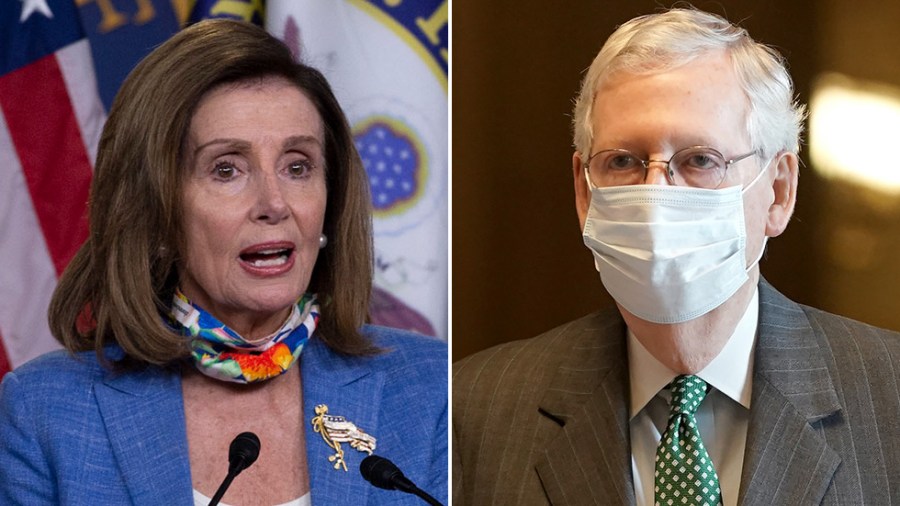
- Both Senate Majority Leader Mitch McConnell (R-Ky.) and Speaker Nancy Pelosi (D-Calif.) say they think they’ll be able to get a deal, but leaders haven’t yet started negotiating and both sides have appeared skeptical of the other’s key priorities.
- Senate Minority Leader Charles Schumer (D-N.Y.) said there had been no outreach from McConnell as lawmakers return to Washington for the first time in two weeks.
The Hill’s Jordain Carney breaks it down here.
The big differences:
- Republicans are looking at a price tag of around $1 trillion, though some have put it closer to $1.3 trillion, significantly less than the roughly $3 trillion bill that passed the House in late May.
- Democrats want to extend a $600 per week increase of unemployment benefits, which is a non-starter for many Republicans, who don’t want the benefit to be more than 100 percent of a person’s previous wages.
- House Democrats also included about $1 trillion in their bill for more help for state and local governments. Many GOP senators, however, are opposed to providing more funding above the $150 billion included in the March $2.2 trillion CARES Act.
The path ahead:
- Treasury Secretary Steven Mnuchin and White House chief of staff Mark Meadows will come to Capitol Hill on Tuesday to brief Senate Republicans on the forthcoming coronavirus relief bill.
- Top Republican senators are warning they oppose including a payroll tax cut in the next coronavirus relief bill, even though it’s a top priority for President Trump.
- GOP lawmakers are considering reducing emergency unemployment benefits to between $200 and $400 per week, The Washington Post reported Sunday.
“The scarring of the economy happening in real time” As lawmakers spar over boosted unemployment benefits, the U.S. is facing significant long-term economic damage from the coronavirus.
- More than 1 million Americans have filed new claims for unemployment benefits each week for the past four months.
- Roughly 30 million Americans — 11.9 percent of the workforce — were receiving some form of unemployment insurance as of the first week of July.
- And while millions of furloughed workers returned to their jobs in May and June, another 2.9 million workers were permanently laid off during that period.
Economists say the persistently high jobless claims coupled with the growing number of permanent job losses are troubling signs for both workers and the economy.
“The main thing that we’re seeing right now is the scarring of the economy happening in real time. We are seeing more people becoming permanently unemployed. We are seeing people continue to get laid off,” said Martha Gimbel, senior manager of economic research at philanthropic investment firm Schmidt Futures.
“We are worried about people getting evicted. We are worried about people being unable to feed their kids. This isn’t about stimulus. This is about support, and I think it’s really important to distinguish between those two things,” she said.
On tap tomorrow
- The Senate Finance Committee holds a hearing on the nominations of Michael N. Nemelka to be a Deputy United States Trade Representative, and of Christian N. Weiler and Alina I. Marshall to be judges of the United States Tax Court, 10 a.m.
- The Senate Banking Committee holds votes on the nominations of Judy Shelton and Christopher Waller to the Federal Reserve Board of Governors, 2 p.m.
LEADING THE DAY
S&P 500 erases 2020 losses: The S&P 500 on Monday erased its losses for 2020, accentuating a remarkable stock market comeback that some critics say is disconnected with the economic pain continuing in the real economy.
With a 27-point, or 0.8 percent, increase, the S&P 500 closed at 3,252, above the 3,230 level where it closed at the end of 2019.
Meanwhile, the Dow Jones Industrial Average was flat with a gain of 9 points, while the tech-heavy Nasdaq composite gained 264 points, or 2.5 percent, outperforming broader indexes.
The Hill’s Niv Elis has more here.
Watchdogs question Treasury on national security loan to trucking company: The congressional coronavirus response oversight panel on Monday questioned why the Treasury Department lent $700 million to a cash-strapped shipping company in an effort to protect national security.
In a report released Monday, the Congressional Oversight Commission charged with monitoring trillions of dollars in emergency relief said it would look deeper into how and why shipping firm YRC Worldwide received a rescue loan meant for companies essential to national defense.
“The Commission intends to explore the decision to designate YRC as critical to maintaining national security, in part, because the risk of loss of U.S. taxpayer money on this loan appears high,” the panel wrote.
“The level of risk taken in the loan to YRC appears strikingly higher than the risks associated with the other facilities over which the Commission has oversight.”
GOOD TO KNOW
- President Trump is stepping up his economic attacks on Joe Biden, seeking to regain strength on an issue once seen as his golden ticket to reelection.
- Morgan Stanley committed Monday to measuring how its loans and investments impact climate change, becoming the first major U.S. financial institution to join a coalition accounting for carbon in finance.
ODDS AND ENDS
- An Amazon warehouse worker says she was written up for taking too many breaks at work earlier this month.
- Lobbying activity boomed in the second quarter of 2020 as the scramble for coronavirus relief prompted companies, trade associations and local governments to turn to K Street for help.